
Introduction
When globall electrical energy is used by the world, ninety percent of it needs to be changed by electromagnetic transformation prior to reaching its intended use. This includes that statistic is one simple part: the magnet wire conductor.
All electric motors in your plant, all transformers in the grid, all EV drivelines on the street require tightly wrapped coils of insulated wire, known to theindustry as magnet wire or winding wire. Despite its commonality however, magnet wire is often misspecified, resulting in early demise, thermal breakdown and high rework costs.
This guide provides engineering procurement teams, OEM designers, and manufacturing engineers a go-to resource for defining magnet wire conductor types, insulation systems, critical specifications, and selection criteria. Whether you‘re procuring wire for a new EV motor or replacing coils in a large industrial transformer these rules will help guide your decisions.
What Is a Magnet Wire Conductor?
Magnet wire is an electrically insulated conductor usually made of copper or aluminum which, when wrapped into a coil and supplied with power, produces an electric and magnetic field; the essential component for any device that must change electrical into mechanical energy.
In Europe and Asia the term “winding wire” is used for the trade while in North America the term “magnet wire” is the name of choice. Whether used or not the product remains identical a precision conductor with a thin but highly engineered coating.
Why is magnet wire different from standard wire?
Unlike general electrical wire cable, magnet wire is designed explicitly for electromagnetic use in which hundreds or even thousands of turns must be crammed into a tightly constrained space. This generates three fundamental design prerequisites that ordinary wire cannot achieve:
Ultra-thin, uniform insulation: The thinner the coating, the more turns (and the greater the electromagnetic field) without risk of dielectric breakdown between turns.
Windability- The wire has to stand-up to the mechanical stresses placed on it by winding (bending, tension and compression) without cracking or delaminating the insulation.
Thermal stability: During operation motors and transformers run at up to 130–180 degreesC (and higher) with thermal cycling. The insulation must be thermally stable.
Cross-Section Shapes
Magnet wire is available in three primary cross-section profiles:
Round wire most commonly used, found in all motors, transformers, solenoids, and many consumer devices. Auto winding processes use round wire, since it is the industry standard.
Rectangular and square: ideal for high power applications (such as large power transformers or traction motors) where a higher fill factor (greater copper in a given volume) is desired.
Flat winding wire (foil conductors) used in specialist types of transformer winding where accurate current sharing and lowest skin-effect losses are important.
Conductor Materials: Copper vs. Aluminum
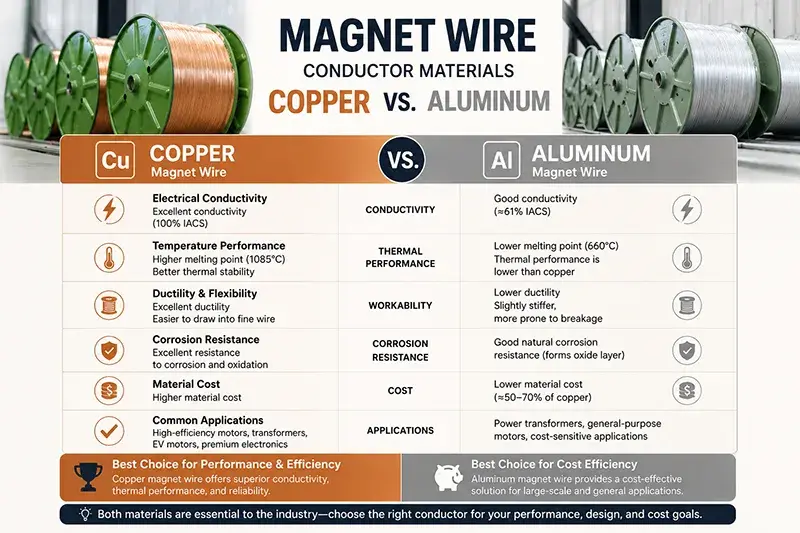
Conductor is the conductive center of the magnet wire. There are significant technical and economics tradeoffs between aluminum and copper conductors which are playing into the decision more and more as EVs and industrial electrification accelerate.
Copper Magnet Wire
More than 99 percent of all applications of magnet wire use copper as the conductor material. The reasons:
Electrical conductivity: the IACS of copper is about 100%, standard to which all other conductors are compared.
Mechanical properties: Copper at a tensile strength, ductility and elongation allows it to be very windable with no strand breaking.
Solderability and termination: Copper terminates dependably and, with polyurethane coatings, after simple mechanical removal it can be soldered directly.
Thermal conductivity: Copper is better at dissipating heat from I2 R losses than aluminum.
The best grade as regards magnet wire application is full annealed electrolytic refined copper (U. S. Specification), which provides minimum conductivity and close winding. The grades of high purity oxygen free copper are specified for high-temperature service or in cuppered-stand environments.
In the year 2025 the copper magnet wire segment constituted approximately 72% of the total magnet wire market by value.
Aluminum Magnet Wire
Another conductor, aluminum, is used when saving weight or money is more important than higher performance:
Weight advantage: The density of aluminum is approximately 39% lower than copper, which makes it highly desirable for aircraft actuators, electric vehicle applications and long-span overhead line applications where weight is a critical factor.
Cost: Aluminum costs less than half per kilogram as copper. For very large power transformers with large conductor volume, this translates to large savings in material cost.
Conductivity trade-off: Aluminum has ~ 61% of copper electrical conductivity (IACS). This translates into an aluminum conductor having about 50−60% larger cross-sectional area to have the same resistance for a given length, thus partially offsetting the weight advantage.
Oxidation challenge: Aluminum oxides quickly, making termination and splicing difficult. CCA wire manages to offer a middle ground, with copper at a conductor level for oxidation resistance and ease of soldering, with aluminum at the core for weight and cost savings.
Aluminum magnet wire accounts for the largest share within this fastest growing/ most dynamic conductor category, which is expected to achieve a CAGR of well over 5% through 2034 as a direct result of automotive electrification.
Specialty Conductor Materials
To serve very demanding applications, producers like Elektrisola supply conductors in silver, nickel, gold, brass, stainless steel and different copper-based alloys. These materials provide the following properties:
Silver: maximum conductivity (106 %IACS): used for RF coils and space-grade electronics.
Nickel: excellent resistance to high temperature oxidation, chemistry affect on down hole oil and Gas industry.
Copper alloys: Better tensile strength and fatigue properties for continuous flexing applications.
Another variation that can be used for conductors is plating silver-plated copper or nickel-plated copper, for example. This offers the benefits of the surface treatment combined with the knowledge that the underlying conductor is a good conductor.
Conductor Materials
The primary conductor materials for magnet wires include copper, aluminum, silver, and alloys (such as copper-silver, copper-tin, copper-nickel, and copper-zinc). These alloys enable customizable adjustments to electrical conductivity, mechanical strength, and corrosion resistance for specific application requirements.
Magnet Wire Conductor Requirements – Surface Condition
Bare conductors shall be smooth, clean, and free of dirt, discoloration, corrosion, scales, or slivers, consistent with good commercial practice. Rectangular and square conductors shall be free from sharp, rough, or projecting edges. The corners on rectangular and square conductors shall be rounded so that the arcs of the radii merge smoothly into the flat surfaces. Wire with slight oxidation shall not be a cause for rejection.
Dimensions and Resistivity
The conductor after insulating shall comply with the requirements given for dimensions in the applicable specification in NEMA MW 1000 Part 2. These resistivity values correspond to a conductivity, in percent International Annealed Copper Standard (IACS) of 100 for copper, 61.8 for aluminum, and 60.6 for aluminum EC 1350 alloys at 20°C (68°F). The Magnet Wire resistance shall be determined in accordance with ASTM B193 and shall not exceed the following values:
| Conductors | Maximum Resistivity | |
| Ohm-Circular mil/ft. | Ohm-mm2/m | |
| Copper | 10.371 | 0.017241 |
| Aluminum | 16.782 | 0.027898 |
| Aluminum EC 1350 Alloys* | 17.114 | 0.028450 |
*The use of aluminum EC 1350 alloys with a minimum conductivity 60.6% of the IACS is allowed in place of aluminum if agreed
between the supplier and the user. See ASTM B 233 for composition data.
NEMA Standard specifies a minimum conductivity for copper of 100% IACS and shall not exclude the possibility of the use of coppers over 100% IACS. Likewise, a conductivity of 61.8% for aluminum and 60.6% for aluminum alloys shall not exclude the use of aluminum or aluminum alloys with higher conductivities in either case. The current state of conductor processing has made possible the use of higher conductivity metals.
NOTE—Since coils are a complex electromagnetic system there is no standardized method for calculating the current-carrying capacity of magnet wire. The maximum current density for an insulated magnet wire will be lower compared to a conductor employed in free air. In order to establish a practical maximum current density, users must take into account different variables including wire size, fill factor, space between wires, system design, and application.
Magnet Wire Insulation Systems: Types, Properties, and Thermal Classes
The insulation is perhaps the most engineered part of any magnet wire. In a coating that is frequently much thinner than a human hair, magnet wire must meet electrical, thermal, mechanical and environmental specifications.
Understanding Insulation Build
nsulation build (Thickness of insulating coating added to conductor circumference). Four standardized build levels have been defined under NEMA MW 1000:
| Build Level | Description | Typical Use |
| Single | Minimum coating | Space-constrained, precision coils |
| Heavy | Standard industrial | Most motor and transformer applications |
| Triple | Extra protection | High-voltage coils, harsh environments |
| Quad | Maximum tdickness | Specialty high-voltage applications |
A wider cross- section of more robust construction enhances the dielectric strength and mechanical protection, but lowers the conductor fill factor and increases overall diameter of the wire.
Thermal Classification
The thermal class of a magnet wire insulation relates to the maximum temperature at which the wire is rated to have an established service life (generally 20,000 hours) when operated continuously to the IEC 60172 / NEMA MW 1000 test procedures. The NEMA-rated thermal classes are:
| tdermal Class | Max Temperature | Common Insulation Types |
| 105 (A) | 105°C | Oleoresinous enamel |
| 130 (B) | 130°C | Modified polyester |
| 155 (F) | 155°C | Polyester, polyuretdane-nylon |
| 180 (H) | 180°C | Polyester-imide, polyamide-imide |
| 200 (N) | 200°C | Polyamide-imide over polyester-imide |
| 220 (R) | 220°C | Polyamide-imide, modified systems |
| 240 (C) | 240°C | Polyimide (Kapton-type), ML |
Important design consideration: Thermal class is a statistical lifetime; it is not a guarantee of performance. Wise wire designers always derate their wire selection / rate wire for the application‘s steady-state operating temp (e.g. select Class 180 wire where steady state is 155-165 degreesC). This derating adds a reliability cushion in case of thermal hot spots, ambient temp excursions, overcurrent conditions.
Major Insulation Types
Polyurethane (UEW / MW 2/79C)
Most commonly specified type where performance is required, typical performance. Polyurethane insulation is directly soldereable without mechanical stripping. This removes a production step in relay, solenoid and small transformer production. Available thermal classes 155 degreesC and 180 degrees C. Typical applications, relay, ignition coils, solenoids, small transformers.
Polyester (PEW)
Provides excellent chemical resistance and value for money. Commonly used for fractional horsepower motors, domestic appliances and general industrial coils. Thermal class normally 155 degreesC. Not directly solderable, termination to be stripped mechanically or chemically.
Polyester-Imide (EIW)
Enhancement of polyester (above ) with imide groups for insulation and long-term stability up to 180 degreeC. Also shows great improvement in approval to various refrigerant oils (essential for hermetic motor use in air-conditioning and refrigeration compressors). The world‘s most popular insulation system for medium-power industrial motors.
Polyamide-Imide (AIW / PAI)
The workhorse of high performance industrial applications. PAI provides an excellent balance of high temperature (200 220 0degreesC), chemical resistance and mechanical properties. Frequently used as a topcoat over a polyester-imide basecoat to give the two-layer 200 class system common in high end motors, traction drives and dry type transformers.
Polyimide (PI/ML)
Achieved by existing magnet wire insulation. A polyimide (Kapton-type) or the more advanced ML type product reaches a 240 degreesC thermal class, offering excellent chemical solvent, irradiation and mechanical cut-through resistance. It is used for cryogenic coils, aerospace hermetic sealed relays, fractional and integral HP motors in the worst environments, downhole oil field tools.
PEEK (Polyether-Ether-Ketone) Emerging
An emerging contender, PEEK insulation provides a high temperature resistance up to 220 degreesC with higher dielectric strength and thinner levels of insulation (thus, providing a higher fill factor for the copper) and mechanical flexibility suitable for automated winding. Bekaert launched its Ampact PEEK-insulated copper magnet wire in February 2025 for electric vehicle motor stators running at 800V+, and is quite indicative of the thermal and performance limits that the industry is approaching.
Wire Gauge and Conductor Sizing
Wire gauge is a direct indication of the coil resistance, maximum current capacity, and number of turns which will fit into a certain winding window.
AWG System (North America)
The American Wire Gauge (AWG) standard is used in North America for the diameters of single strand, solid, round conductors. The AWG sizes are numbered from the largest (0.460 inch diameter 0000 AWG) to the smallest (0.0022 inch diameter 44 AWG). In the production of fine magnet wire diameters as small as 0.0008 mm (8 microns) are manufactured for use in precision coils in medical equipment, micro electro-mechanical systems (MEMS) sensors, hearing aid actuators.
Essential principle
Higher the AWG number, the thinner is the wire. Thinner wire: less current carrying capacitybut higher resistance per meter. Higher the number, steeper the turns per meter, hence higher the inductance and turns ratios of the transformer.
Metric Sizing (IEC)
The IEC system described the conductors diameter in millimeters. Specifications for film insulated winding wires are laid out in international IEC 60317 series of standards.
Resistance and Electrical Properties
Conductor sizing calculations must account for:
IACS conductivity of material used for conductor
Temperature coefficient of resistance (how much resistance drops with rising temperature vital for estimating coil resistance working at operating temperature rather than at room temperature)
Correction factors for ambient temperature and thermal insulation loss of allowable ampacity
Key Applications of Magnet Wire Conductors
Magnet wire is present in just about every corner of today ‘s economy. Knowing where it ‘s used aids purchasing groups to stay aligned on the needs to specifications.
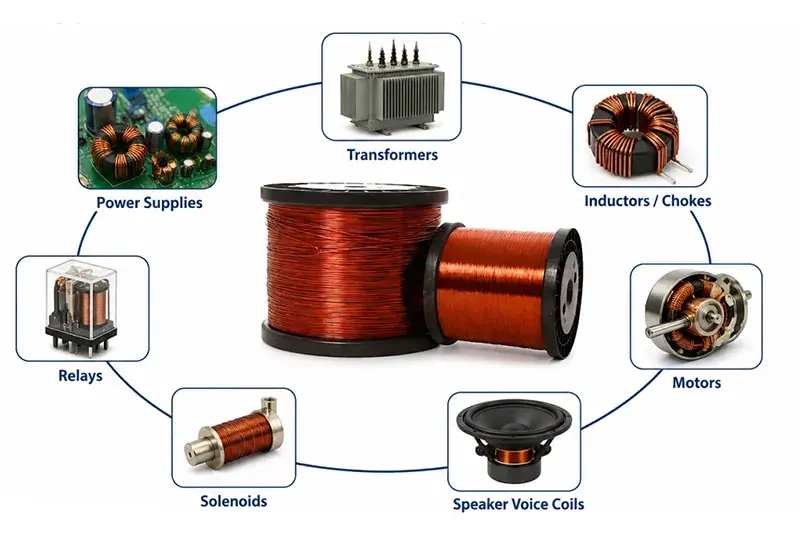
Electric Motors
The one major use of magnet wire the range from sub-fractional horsepower appliance motors, up to multi-megawatt industrial drives. Motor windings translate electric current into a rotating magnetic field which in turns produces mechanical work. Thermal class (driven by duty cycle and cooling type), insulation build (driven by voltage and winding machine type), conductor shape (round wire for most; hairpin flat wire for high efficiency EV traction motors).
Power Transformers
Power transformers employ magnet wire coils to facilitate the transfer of electrical energy from one voltage level to another via electromagnetic induction. Distribution transformers, dry-type transformers and instrument transformers are the prime users of rectangular foil conductors and copper round wire conductors. The compatibility of the insulation with the transformer oils and potting compounds is an important parameter for specifications.
Electric Vehicles (EVs)
The fastest expanding application market. EV traction magnet wire requires a higher thermal class rating, inverter-driven PWM waveforms (which introduces partial discharge loading), as well as, more often than not, a hairpin conductor geometry that lends itself to automated stator manufacturing and higher slot fill factors. The move to 800V+ EV architectures in premium vehicles adds to this requirement for dielectric strength and partial discharge capability.
Industrial and Consumer Electronics
Inductors, solenoids, relays, speakers, voice coils, electromagnets are found in an enormous variety of industrial controls, instrumentation and commercial and domestic appliances. Delicate magnet wire (<0.1mm diameter) is used in actuators for hard disk drives, medical implants and delicate scientific instruments.
Generators and Renewable Energy
Enabling several significant growth applications, such as wind turbine generators and solar inverter transformers, remains the magnet wire industry-leading position as a major element of the global energy transition. Applications rely on magnet wire with extended outdoor service life and resistance to moisture ingress.
Aerospace and Defense
Hermanics sealed relays, avionic transformer windings, and actuator coils on aircraft flight control systems require highest reliability grades (usually Class 200 or 240 degreeC, polyimide-insulated, with strict lot traceability). Aerospace demands for weight reduction require aluminum and CCA conductor testing.
Magnet Wire Market Overview: Size, Growth, and Key Players
The worldwide magnet wire market ranks among the most basic subdivisions of the electric components sector, driven by wide megatrends in electrification, energy efficiency and transportation revolution.
Market Size and Growth
Several analyst firms estimate a 2024–2025 global market value of $30–36 billion, with a generally agreed-upon 4–5.5% CAGR over the early 2030s. The market is expected to reach $40–53 billion by 2030–2034, depending on the determine methodology and coverage.
Growth drivers include:
EV adoption: Continuous requirements for high-performance traction motor windings are established by worldwide EV manufacturing.
Grid modernization: IEA forecasts that developing the transmission grid alone will require an annual investment of over $200 billion, on average, by the mid-2030s. This will directly fuel demand for transformer conductors.
Factory automation and robotics: Factory automation and robotics are driven by widespread application of induction and servo motors.
Consumer electronics Smartphones, wireless charging stations, and hearing aids all incorporate fine-magnet wire coils.
Asia-Pacific dominates most regional markets, with China and India leading the region. Due to the fast pace of industrialization and local EV manufacturing, this area accounts for the largest regional share.
Major Manufacturers
The magnet wire market includes both global conglomerates and specialist manufacturers:
Essex Furukawa (Superior Essex + Furukawa) one of the world‘s largest magnet wire suppliers; recorded 43,000 tonnes of reclaimed recycled copper scrap in FY 2024, receiving Copper-Mark accreditation.
Sumitomo Electric Industries large supplier with own strong demand for electric vehicle (EV) hairpin wire, explains recent growth in volume.
Elektrisola fine wire process specialist (to 0.008 mm diameter); 30,000+ product variants.
LS Cable & System Ltd. Key playerin Industrial and Power applications.
MWS Wire Industries North American specialty wire supplier for aerospace, medical and precision electronics.
Precision Wires India Ltd, Sam Dong, Tongling Jingda – big regional producers and expanding in world markets.
Zhengzhou LP Industry CO.,LTD. – professional manufacturer of enameled copper and aluminum wire in world market.
Frequently Asked Questions
Q: What is the insulated wire used for the winding (the magnet wire)?
A: Magnet wire is a special insulated wire that can be wound into tight coils for magnetic fields and such. Its insulation is much thinner than a normal electric cable since packing density of the wire is the most important factor, normal electric wire has a much thicker insulation due to the need for protection.
Q: Explain why it is found that copper is the best conductor to use on the magnet wire?
A: While offering high conductivity, Copper also posses great ductility (for clean winding without breakage), good heat conduction and good solderability or mechanical termination. While balancing the Chem., Phys.&Mechan. Property requirements altogether, copper remains king as the conductor material of choice.
Q: What thermal class do I need for an industrial motor?
A: Note that for most general purpose industrials, over 155 degreeClass F and 180 degreeClass H rated wire is specified. Unless you are concerned with the fan or blade (p/n), which are caused by the duty cycle, ambient, and cooling method and if the design balls the winding at its nominal rating, then the proper sizing depends on the duty cycle, how hot the room is, the cooling method, and how close the design operates to the rated temperature. Normally, for maximum reliability designers derate using Class 180 wire at usual steady state temperatures of 155 – 165 degreeClass F (68 – 74 degreeClass C) to give a real thermal headroom.
Q: What is single versus heavy build insulation?
A: Build is the quantity of insulation on the circumference of a conductor. Single build is the minimum amount of build that can be used, in applications where space is limited and voltages are low. Heavy build is the standard commercial specification, with heavier builds providing increased dielectric strength and mechanical protection. Heavier build also decreases the conductor fill factor (the percentage of the coil that a given build consumes of the available winding area), which can slightly decrease the efficiency of the coil.
Q: Is the magnet wire suitable for use in high-voltage applications?
A: Sure. Is insulation design different for high voltage? A: Sure. The insulation system need to be particularly qualified for the voltage stress that it will be put through. For high-voltage that is any thing (including 800V+ EV drivetrains) and that is medium-voltage transformers, engineers will specify more insulation build, uses of partial discharge resistant enamels, and even more layer-to-layer insulation to prevent break down.
Q: Is there a specification for magnet wire?
A: In North America, NEMA MW 1000 (currently ANSI/NEMA MW 1000) is the relevant standard. For international use, IEC 60317 standards govern. In Japan, JIS C3202 applies. Virgin media wire suppliers typically produce cable that meets 2 or more of the these standards, with certification available. In addition, compliance to RoHS is required for the EU market.
Conclusion
Magnet wire conductor is probably the single most important but least well defined aspect of today‘s electrical engineering. Simply choosing the right specification conductor material, insulation type, thermal class, gauge, and build can mean the difference between reliable long term operation and premature failure.