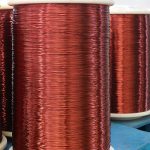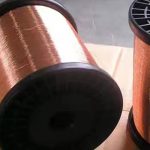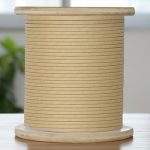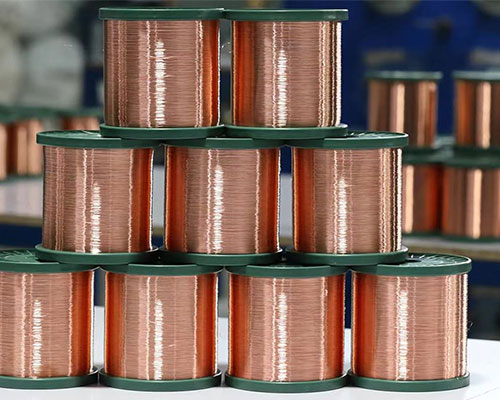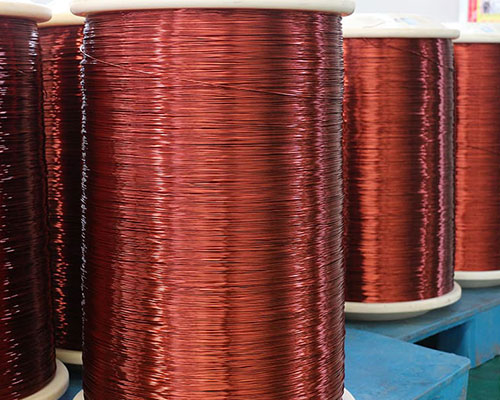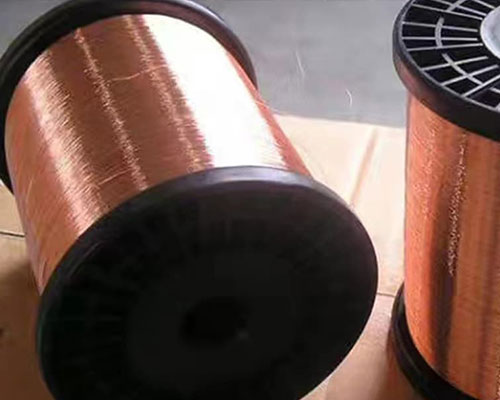
155°C polyester enameled round copper wire is the standard for Class B and Class F motors, transformers and relays. LP Industry provides this as IEC 60317-3; GB/T 6109.2-2008 wiring from 0.10 mm to 5.00 mm in diameter, with Grade 1 or Grade 2 insulation builds. Engineers choose for excellent thermal stability, high solvent resistance and consistent winding characteristics at an economical price.
What Is 155 °C Polyester Enameled Round Copper Wire?
155°C Polyester enameled round copper wire (PEW) – magnet wire that consists of an annealed copper conductor and a polyester resin enamel with a continuous working temperature rating of 155 °C (or thermal class F). It is used in motor, transformer, generator, relay windings.
The enamel film is constructed of multiple baked coatings, which are applied as Grade 1 (thinner build, higher slot fill) or Grade 2 (thicker build, more dielectric margin) in accordance with IEC 60317-3 and GB/T 6109.2-2008. This construction imparts excellent abrasion resistance and good chemical resistance to commonly encountered solvents and a cut-through temperature of approximately 270 deg C.
The choices make this wire suitable for Class B and Class F electrical equipment, with a 155°C temperature index required and where very good, low cost insulation with consistent winding properties are more important than higher thermal classes such as 180°C or 200°C.
How It Works?
Polyester enameled wire manufacturing process involves passing the wire through a series of coatings and baking in a vertical enameling tower.
Bare annealed Copper wire is reduced in size to the required conductor diameter.
The wire enters a polyester varnish applicator and then passes through dies, which set the film thickness for each pass.
Every coated layer is cured in a high temperature oven which causes the polyester resin to cross link into a tough, continuous film.
2–3. Repeat steps until desired wire code is achieved (Grade 1 or Grade 2 build). The wire is then cooled, tested and spooled.
The above process is why the enamel survives the mechanical load of the coil winding and operates at 155 °C continuous operating temperature which in turn influences the insulation life of the motor/transformer.
Key Specifications & Technical Parameters
Temperature index: 155°C
Insulation building: Grade 1, Grade 2
Sizes: 0.1mm – 5mm
MOQ:500kg
LP Industry produces 155 °C Polyester enameled round copper wire with very close dimensional and electrical tolerances. The following table highlights the parameters engineers most frequently define when specifying this wire for motor or transformer applications:
| Parameter | Value / Range |
| Conductor material | Electrolytic annealed copper, ≥99.9% IACS conductivity |
| Conductor diameter range | 0.10 mm – 5.00 mm (0.01 mm increments) |
| Thermal class | 155°C (Class F) |
| Insulation type | Polyester enamel (PEW/QZY-2 type) |
| Insulation build | Grade 1 or Grade 2, per IEC 60317-0-1 |
| Applicable standards | IEC 60317-3, GB/T 6109.2-2008, NEMA MW 5-C (verify with manufacturer) |
| Dielectric breakdown voltage | ≥4.5 kV at 0.50 mm, Grade 2 |
| Elongation at break | ≥20% (verify with manufacturer) |
| Heat shock | No film cracking after 1h at 155°C, 20% pre-elongation, wound on own diameter |
| Cut-through temperature | ≥270°C |
| Solvent resistance | No film removal under pencil hardness H, standard test solvents |
| Standard packaging | Plastic or wood spools, 1 kg – 100 kg per spool (verify with manufacturer) |
Standards & Certificates
- GB/T 6109.2-2008: Enameled Round Winding Wire – Part 2: Polyester Enameled Round Copper Wire, Grade 155
- IEC 60317-3:2004: Winding Wires – Part 3: Polyester Enameled Round Copper Wire, Grade 155
- IEC 60317-3 Specifies the mechanics and electrical specifications of The Grade 155 polyester enameled round copper wire to meet worldwide standards for the design of motors and transformers.
- GB/T 6109.2-2008 one of the Chinese national standards for Grade 155 Polyester enameled round copper wire used for equipment made for or sold into China.
- NEMA MW series (check with manufacturer)
- North American standard for dimensions and performance of magnet wire, used for equipment imported into the US.
- RoHS Confirms of the enamel and any surface coatings meeting limits for restricted hazardous substances, it is a required compliance statement for all equipment headed for sale within the EU.
- ISO 9001 – Certifies that manufacturing is within a certified quality management system. This can guide suppliers to be assured of consistent batch-to-batch quality of insulation.
Standards and Technical Requirements for Round vs. Rectangular Enameled Wires
| Item | Round Wire | Rectangular Wire |
|---|---|---|
| Geometric Structure | Circular cross-section, uniform stress distribution on the enamel film | Rectangular cross-section with sharp edges, higher stress concentration on enamel during winding |
| Typical Applications | General motors, transformers, standard electrical equipment | High slot filling factor and high power density equipment (e.g., large motors, traction machines, high-voltage transformers) |
| Enamel Film Requirements | Sufficient insulation and dielectric strength for standard use | Stricter requirements on crack resistance, uniformity of enamel thickness, and mechanical durability at conductor edges |
| Technical Challenges | Control of conductor dimensions and enamel thickness tolerance | Maintaining enamel integrity at sharp corners; resistance to mechanical stress during winding |
| Standards (Examples) | IEC 60317 series (Part 0–3 for round wire, such as IEC 60317-3: Polyester enameled round copper wire, Grade 155) | IEC 60317 series (Part 0–29 for rectangular wire, such as IEC 60317-29: Polyester enameled rectangular copper wire, Grade 155) |
| Key Performance Factors | Slot filling factor, dielectric strength, insulation reliability | Higher slot filling factor, dimensional accuracy, and improved winding efficiency |
155°C Polyester Enameled Round Copper Wire Properties
The reliability of 155℃ PEW is derived from the comprehensive advantages of its insulating material polyester resin in thermal, mechanical and chemical properties.
| Performance Category | Test Items/Characteristics | Standard Requirements (GB/T 6109.2-2008) | PEW Performance | Design Significance |
| Thermal | Thermal Index (TI) | 155℃ (F) | Long-term operating temperature limit, excellent thermal stability | Determine the insulation rating of motors/transformers to prevent thermal aging. |
| Mechanical | Abrasion Resistance | Must meet standard weight requirements. | Excellent, suitable for high-speed winding operations. | Reduce insulation damage and coil short circuits during automated production. |
| Mechanical | Flexibility/Wrapability | Requires passing elongation and sharp bend tests. | Excellent resistance to cracking compared to PVF wire. | Ensures the paint film does not crack after the coil is bent. |
| Mechanical | Paint film adhesion (K value) | must meet minimum standards. | A good foundation is required; composite paint can achieve a K value of over 170. | Reliable bond between the paint film and the copper core, resisting mechanical stress. |
| Chemical | Solvent Resistance | Requires passing standard immersion solvent testing. | Excellent chemical and solvent resistance | Suitable for immersion coating processes and specialized liquid immersion environments (such as submersible motors). |
Core Benefits
155 °C continuous thermal rating → is equivalent to a Class F motor and transformer temperature rating (180 °C polyesterimide wire costs more).
Grade 1 and Grade 2 insulation construction → give engineer way to trade off the slot fill factor against dielectric margin for each winding design.
High solvent and abrasion resistance → this ensures minimal damage to the insulation during automated coil winding, inserting and varnish impregnation.
Dimensional stability to IEC 60317-0-1 → retains conductor diameter and eccentricity in tolerance, better slot fill predictability from batch to batch.
Cut-through resistance above 270 deg C → protects the device from shorts caused by the heat produced by soldering and any contact pressure from neighboring turns.
Complete size range from 0.10 mm to 5.00 mm → relays to high current transformer windings in one product line. Reduce supplier consolidation.
Applications & Use Cases
155 °C polyester enameled round copper wire this is the standard winding wire for Class B and Class F electrical equipment made to economical, high production volumes. It provides the essential thermal, mechanical toughness and cost to be the wire of choice for general-purpose motors, transformers and electro-magnetic components.
Most of manufacturers prefer to use Grade 1 build for the compact coil where space for the winding is limited, while Grade 2 build for the coil requiring additional dielectric margin or multiple rewinding. Typical application is:
Single-phase and three-phase induction machine stator and rotor windings (Class B/F)
Distribution and control transformer, up to medium power ratings2.
Home appliances motors fans, washing machine motors, range hood motors
Air conditioning and refrigeration compressors windings
The use of relays, solenoids and electromagnetic contactor coils;
Winding of ballast and lighting transformers
Submersible pump motor windings
Power tool armature and field coils
155°C Polyester vs. 180°C Polyesterimide Enameled Wire
| Attribute | 155°C Polyester (Class F) | 180°C Polyesterimide (Class H) |
| Thermal class | 155°C | 180°C |
| Enamel chemistry | Polyester resin, single-chemistry build | Polyester base coat with polyimide topcoat |
| Cut-through temperature | ≥270°C | ≥330°C (verify with manufacturer) |
| Typical cost position | Lower | Higher (verify with manufacturer) |
| Best suited for | General-purpose Class B/F motors and transformers | High-temperature motors, VFD-driven motors, compact high-density windings |
| Standard reference | IEC 60317-3 | IEC 60317-8 |
Select 155C polyester wire where the insulation system is well classified, Class B or Class F and normal operating margins are respected. Select 180C polyesterimide where winding temperatures can be increased beyond 155C due to ambient heat, VFD induced voltage stresses, or compact slot windings. Polyesterimide is more expensive, but increases life under thermal stress.
Frequently Asked Questions
Q: what differentiates grade 1 from grade 2 insulation?
Grade 1 is a finer enamel film (less in overall wire diameter), improving slot fill factor. Grade 2 is a thicker film, providing higher dielectric strength and better mechanical protection. Most general purpose motors are Grade 2; a limited number of space critical machines specify Grade 1.
Q: Is 155 °C polyester wire suitable for Class F motors?
Yes, 155 °C is the proper Class F insulation for motors and transformers. Its temperature index conforms to the Class F system; there is no need to derate for thermal reasons. It is also perfectly acceptable for Class B (130 °C) appliances.
Q: What diameters does LP Industry have?
LP Industry: Polyester enameled round copper wire is manufactured in 155 °C, 0.10 mm – 5.00 mm (0.01 mm steps). 0.10 mm- 5.00 mm, Grade 1 and 2 insulations are produced in this range. If a different diameter is required please discuss.
Q: minimum order quantity?
MOQ varies according to wire diameter, insulation grade and spool packaging and is usually from 500kg per specification. Smaller trial quantities are available for new customers. Please speak to your local team with your required diameter and grade for an exact MOQ and lead time.
Q: How is it so different from PVC- or nylon-jacketed cable?
PVC- or nylon-jacketed wire is used for hookup or lead wire, not magnet wire windings. Polyester enameled wire, which is 155 °C polyurethene, puts a very thin layer of continuous paint directly onto the copper, which is necessary for the close slot tolerances and the performance in the coils of a motor or transformer.
Q. Will this cable work for VFD driven motor?
155 °C polyester wire is suitable for VFD driven motors within acceptable thermal limits, although it is not the preferred choice for high frequency PWM applications. Polyesr wire at 180 °C or polyesterimide or corona resistant wire should be used where VFDs induce large voltage spikes or high temperatures at the motor.