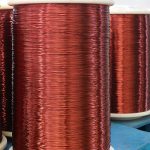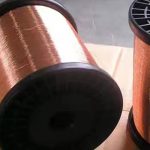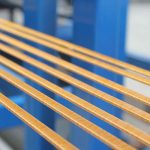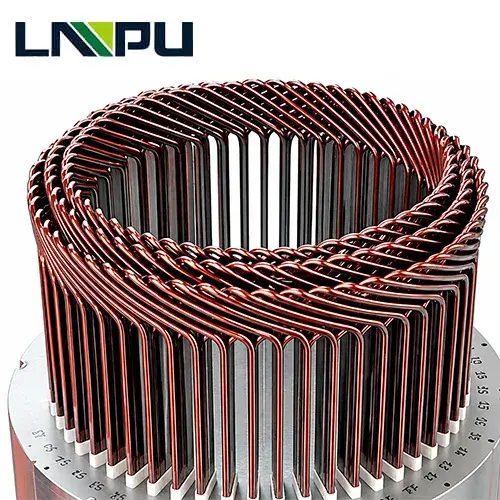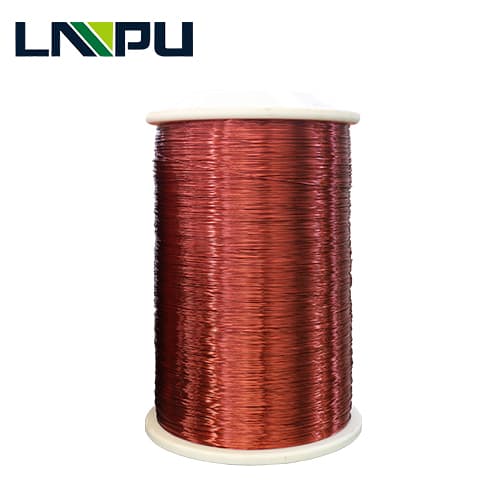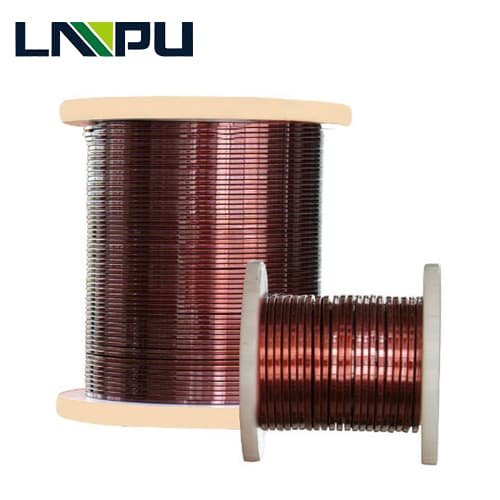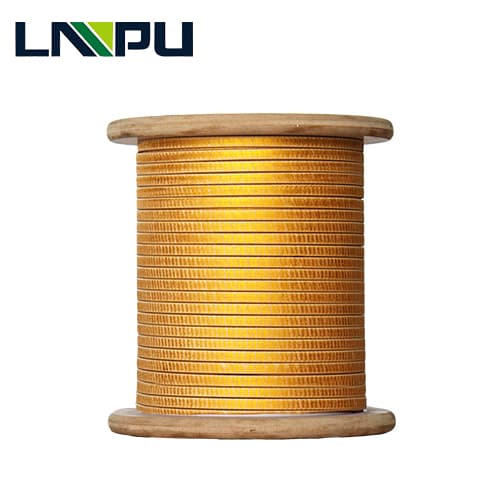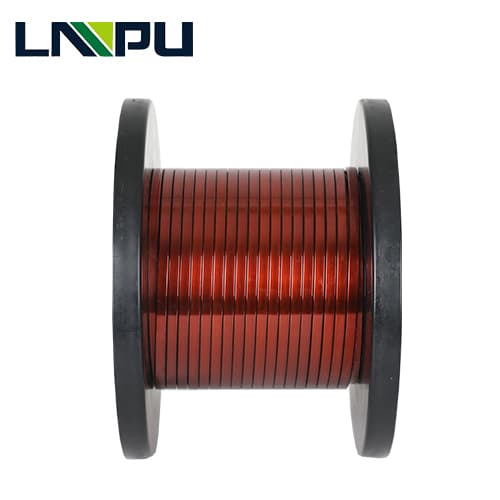
Without a bobbin, a small coil needs wire to do more than just conduct it needs to keep its shape. Self-bonding enameled copper wire bonds neighboring turns together when heated or solvent activated, establishing a stiff, self-supporting shape on the fly. Engineers use the material to cut down coil weight, do away with bobbins and fit more in tight electromagnetic spaces.
What Enameled Copper Wire Means Self-Bonding Enameled Copper Wire?
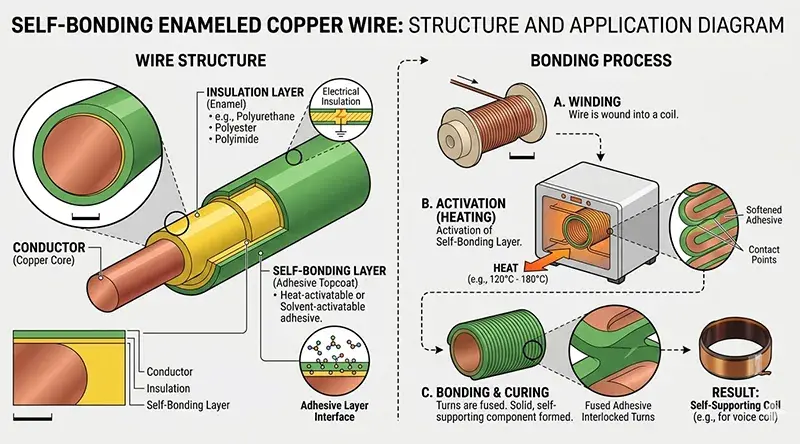
Self-bonding enameled copper wire is a magnet wire type which is coated with the standard layer of enamel insulation and an additional overcoat of bonding material, for the creation of a rigid self-supporting coil without the need for any former or bobbin. When subjected to a heat or solvent, the bonding layer softens and joins neighboring wire turns together by fusion. It then re-solidifies on cooling. This results in a self-supported, dimensionally stable coil structure.
The base conductor (the wire itself) is high-conductivity copper (whose grade is either ETP or OFC). The main enamel that separates each conductor from the others is normally either polyurethane or polyesterimide. Furthermore, the bonding overcoat (to hold the conductors together and to insulate them) normally is polyvinyl butyral (PVB) or an epoxy-phenolic resin, depending on the target activation temperature and thermal class.
This wire, then, is used in places where the additional weight of bobbins is unacceptable, where the winding geometry is required to be perfectly controlled, or where a reduction in assembly steps is needed.
How the Bonding Mechanism Works
Self-bonding wire forms a rigid coil through a straightforward two-stage process:
Wind the coil on on a temporary former or mandrel, ready for winding at room temperature. The bonding over coat, being an inert material, will not affect the winding tension or layer alignment.
Bond is activated by heat (120 degreeC~160 degreeC for most grades) or a suitable solvent such as MEK or acetone. The bond coat of wire becomes tacky and wets the bare wire surface.
Allow to cure. Take away heat or solvent. The bonding layer hardens and either chemically or mechanically engages with adjacent turns.
Remove the coil from the mold. You should be able to support the completed coil without a bobbin, glue or tape.
The resulting coil is a mechanically stable, small coil which is uniformly shaped from lot to lot.
Key Specifications & Technical Parameters
| Parameter | Value / Range |
|---|---|
| Conductor material | Electrolytic tough pitch (ETP) copper or oxygen-free copper (OFC) |
| Conductor diameter | 0.05 mm – 1.20 mm (AWG 44 – AWG 18) (verify with manufacturer) |
| Primary insulation | Polyurethane (UEW), polyesterimide (EIW), or polyester (PEW) |
| Bonding overcoat | Polyvinyl butyral (PVB) or epoxy-phenolic resin |
| Temperature class | 130°C (Class B), 155°C (Class F), 180°C (Class H) (verify) |
| Heat activation temperature | 120°C – 160°C typical (verify per grade) |
| Dielectric breakdown voltage | ≥ 500 V (thin film) to ≥ 2,000 V (heavy build) (verify) |
| Bonding strength (after activation) | ≥ 10 N/mm² typical (verify with manufacturer) |
| Elongation at break | ≥ 15% (copper conductor) |
| Solderable | Yes — polyurethane grades solder directly without pre-stripping |
Core Benefits
Self-supporting coil construction -> no bobbins/formers; reduces parts count by 30-50% in typical coil assembly and improves assembly times
Exact geometry held in shape -> bonded turns overcome vibration induced displacement, thus ensuring inductance and impedance to remain in +/-1–2% over service life (Check manufacturer data)
End winding packing density -> removal of the bobbin wall recovers working winding window; copper fill factor rise and the thermal characteristics are better.
Possible to match during thermal class flexibility -> ClassB, F and H grades are accessible, covering utilisation atmospheres from 130 degreesC to 180 degreesC non-stop service
Direct solderability (polyurethane grades)-> no stripping or abrasion needed prior to soldering, providing quicker termination time and less operator error.
Reliable, repeatable results->activation is process-controlled and auditable, providing coil-to-coil dimensional stability across production runs
Applications & Use Cases
Self-bonding enameled copper wire is the design solution where the following conditions are of prime importance space saving coil geometry, self-supporting coil manufacturing, or easy-to-assemble device. Its application spans various industries from precise military and industrial tools to high-cycle industrial machinery.
Typical applications include:
Brushless DC (BLDC) motor stators? Coreless and air-core winding configurations for drones, servos, and medical drives
Voice coil actuators, such as Speaker Voice Coil Enamel Wire for loudspeakers, autofocus lens drives, and linear actuator coils that require tight dimension control, low mass, and precise operating performance.
High frequency transformers core for switching power supplies (SMPS), EVs onboard chargers (without bobbin).
Ignition coils and automotive sensors under-hood applications with Class F/H thermal requirements
Inductors and chokes Toroid and solenoid inductors for EMI filtering and power conditioning
Medical devices MRI gradient coils, sensor coils to be implanted in the body for various applications, sensors to be used in conjunction with minimally invasive surgical devices
Aerospace solenoids and relays weight-dependent flight hardware where the elimination of the bobbin is a spec requirement
Test & measurement instruments Precision coils in Hall sensors, current transformers and impedance standards
Customization Options & Buying Guide
When choosing self-bonding wire the four parameters must match your application.
- Conductor diameter (gauge)
Use finer wire (AWG 36–44 / 0.05–0.13 mm) for high-turn-count, high-impedance coils and coarser wire (AWG 18–28/ 0.32–1.0 mm) for high-current, low-resistance windings. Rate your coil‘s resistivity according to its gauge. - Temperature class
Choose Class B (130 degrees C) for general purpose motors and transformers. Allow Class F (155 degrees C), or Class H (180 degrees C) for high power density designs, automotive under-hood use or industrial application using continuous duty. - Bonding activation method
A heat-activated grade is the standard choice for large-volume production using oven or resistance heating. A solvent-activated grade is best suited for small-batch production, product development work, or situations where heating the coil assembly is less feasible. - Primary enamel type
Polyurethane grade are practically solderable which is most popular for electronics manufacturing. Polyesterimide and polyester grades give better thermal and chemical resistance for challenging settings.
| Diameter of Conductor (mm) | Conductor tolerance (mm) | Insulation thickness (mm) | Mini. slef-bonding layer (mm) | Max. Finished overall Diameter (mm) | ||
| Grade 1B | Grade 2B | Grade 1B | Grade 2B | |||
| 0.02 | 0.002 | 0.004 | 0.002 | 0.026 | 0.029 | |
| 0.022 | 0.002 | 0.005 | 0.002 | 0.03 | 0.033 | |
| 0.025 | 0.003 | 0.005 | 0.002 | 0.034 | 0.037 | |
| 0.028 | 0.003 | 0.006 | 0.003 | 0.038 | 0.042 | |
| 0.032 | 0.003 | 0.007 | 0.003 | 0.044 | 0.048 | |
| 0.036 | 0.003 | 0.004 | 0.008 | 0.003 | 0.05 | 0.055 |
| 0.04 | 0.003 | 0.004 | 0.008 | 0.003 | 0.055 | 0.06 |
| 0.045 | 0.003 | 0.005 | 0.009 | 0.003 | 0.062 | 0.068 |
| 0.05 | 0.003 | 0.005 | 0.01 | 0.003 | 0.068 | 0.082 |
| 0.056 | 0.003 | 0.006 | 0.011 | 0.003 | 0.075 | 0.092 |
| 0.063 | 0.003 | 0.006 | 0.012 | 0.005 | 0.085 | 0.101 |
| 0.071 | 0.003 | 0.007 | 0.012 | 0.005 | 0.094 | 0.112 |
| 0.08 | 0.003 | 0.007 | 0.014 | 0.005 | 0.105 | 0.125 |
| 0.09 | 0.003 | 0.008 | 0.015 | 0.005 | 0.117 | 0.137 |
| 0.1 | 0.003 | 0.008 | 0.016 | 0.005 | 0.129 | 0.152 |
| 0.112 | 0.003 | 0.009 | 0.017 | 0.008 | 0.143 | 0.152 |
| 0.125 | 0.003 | 0.01 | 0.019 | 0.009 | 0.158 | 0.168 |
| 0.14 | 0.003 | 0.011 | 0.021 | 0.01 | 0.175 | 0.186 |
| 0.16 | 0.003 | 0.012 | 0.023 | 0.01 | 0.197 | 0.209 |
| 0.18 | 0.003 | 0.013 | 0.025 | 0.01 | 0.22 | 0.233 |
| 0.2 | 0.003 | 0.014 | 0.027 | 0.011 | 0.243 | 0.256 |
| 0.224 | 0.003 | 0.015 | 0.029 | 0.012 | 0.27 | 0.284 |
| 0.25 | 0.004 | 0.017 | 0.032 | 0.013 | 0.3 | 0.316 |
| 0.28 | 0.004 | 0.018 | 0.033 | 0.013 | 0.331 | 0.348 |
| 0.315 | 0.004 | 0.019 | 0.035 | 0.014 | 0.369 | 0.387 |
| 0.355 | 0.004 | 0.02 | 0.038 | 0.015 | 0.413 | 0.432 |
| 0.4 | 0.005 | 0.021 | 0.04 | 0.016 | 0.461 | 0.481 |
| 0.45 | 0.005 | 0.022 | 0.042 | 0.016 | 0.514 | 0.536 |
| 0.5 | 0.005 | 0.024 | 0.045 | 0.017 | 0.568 | 0.59 |
| 0.56 | 0.006 | 0.025 | 0.047 | 0.017 | 0.63 | 0.654 |
Please give all four parameters when requesting a quote to confirm correct stock allocation and lead time.
Self-Bonding Wire vs. Conventional Enameled Wire
| Parameter | Self-Bonding Enameled Wire | Conventional Enameled Wire |
|---|---|---|
| Bobbin / former required | No — coil is self-supporting | Yes, in most designs |
| Assembly steps | Wind → activate → demold | Wind → assemble into bobbin → secure |
| Coil weight | Lower (no bobbin mass) | Higher |
| Winding window utilization | Higher copper fill factor | Reduced by bobbin wall |
| Dimensional stability under vibration | High — turns bonded | Moderate — depends on bobbin fit |
| Unit cost | Higher (bonding overcoat adds cost) | Lower |
| Best fit | Compact, lightweight, or high-density coils | Standard production coils with existing tooling |
For most of the designs where bobbin elimination is possible, the weight savings, the improvement in fill factor, and the reduction in assembly costs overcome the increased cost of wire for the first year of production.
Heat Activation vs. Solvent Bonding
The majority of production environments will utilize heat activation. This choice is due to not only the benefits of the consistency it provides but also because it leaves a process audit trail. Solvent activation will be the default option in R&D and small volume manufacturing.
| Factor | Heat Activation | Solvent Activation |
|---|---|---|
| Activation method | Oven, resistance heating, or hot air | MEK, acetone, or proprietary solvent |
| Cycle time | 30 seconds – 5 minutes depending on coil mass | Near-immediate surface tacking |
| Equipment cost | Low–moderate (standard ovens) | Minimal (solvent applicator) |
| Repeatability | High — temperature-controlled | Moderate — depends on application technique |
| Best for | High-volume automated production | Prototyping, small batch, repair |
| Ventilation requirement | Not required post-cure | Required during activation |
Compliance & Certifications
Self-bonding enameled copper wire is produced and tested to globally accepted standards. Check for recommended certifications before specifying for regulated end products with your supplier.
IEC 60317: international standard for mechanical and electrical properties of enameled winding wire, covering dimensional tolerances, breakdown voltage, and heat shock resistance. The relevant grades are:. IEC 60317-20 (polyurethane); IEC 60317-8 (polyesterimide)
UL Listed (UL 1446 / UL 508C) Mandatory for wire used in UL-listed motors, transformers, and electrical control devices when sold in North American markets.
RoHS EU 2011/65/EU – European Union, restricts the use of hazardous substances in electrical and electronic equipment. Applies to wire in consumer electronics, medical devices and automotive electronics for sale on the EU market.
REACH (EU 1907/2006) Codes for the registration of chemical substances; suppliers should verify that SVHCs are absent from the formulation used for the bonding overcoat.
Frequently Asked Questions
Q: How hot do you have to make your self–bonding enameled copper wire?
Most standard PVB-based self-bonding wire are activated between 120 deg C and 160 deg C. The actual activation temperature depends on the bonding agent grade and cure speed required. Epoxy-based high-temperature grades need to be activated closer to 160 deg C to 180 deg C. Check with wire supplier for the activation profile before setting the process parameters.
Q: Is it possible to solder enameled copper wire where the self-bonding layer has not been stripped?
Yes, but only for PUgrades. PEnamel cures away completely when exposed to those temperature of other typical solderings (350 degreesC–400 degreesC) so that those can be directly-tinned by soldering without necessarily removing coating by mechanical stripback or chemical pre-process.32grades of polyester and polyesterimide have to be potentialtinned by soldering before.
Q: How does Class F self-bonding wire differ from Class H self-bonding wire?
Class F wire is rated for continuous operation at 155°C. Class H is rated at 180°C. Class H applies a higher-temperature-stable primary enamel, and bonding overcoat. Specify Class H for automotive, high-PD motor, or industrial continuous-duty when Class F thermal reserve is not adequate.
Q: Would you recommend using self-bonding wire for high frequencies?
Yes, self-bonding wire are offered in typical round conductor shape in addition to litz wire for frequencies of operation far above 10 KHz. To prevent skin effect losses at switch frequencies above 10 KHz, use a litz-construction self-bonding wire. Confirm construction and number of strands in this conductor for frequencies above 100 KHz.
Q: How about the minimum order quantity (MOQ) of self-bonding enameled copper wire?
MOQ m minimum order quantities also vary by manufacturer and gauge. The standard for most gauges (28–38 AWG) is any spool stock product with no minimum order. However, fine gauges (40–44 AWG) or custom temperature class combinations may have a MOQ of 5–25 kg. Talk to your supplier about their minimum orders spool size, reel type, and custom tolerance requirements.
Q: Is self-bonding wire IEC 60317? compliant?
Official grades will satisfy the IEC 60317 series standards for the specific type of enamel most commonly IEC 60317-20 for polyurethane and IEC 60317-8 for polyesterimide. When obtaining your supplies, please ask your vendor for a CoC and test report that states the conformity of each lot shipment.
Request a Quote for Self-Bonding Enameled Copper Wire
Self-bonding enameled copper wire allows for lighter, smaller, and more reliable coil designs in motor, transformer, and sensor applications. Our team provides complete offering of gauges, temperature classes, and bonding activation types with short lead-times and complete IEC compliance documentation.
Inform us of your conductor diameter, class of temperature, method of Activation and quantity. We will get back to you with Price, Lead time and datashete Confirmed in less than 24 business hours.